


TLDR: Butyloctyl salicylate is appearing in many mineral sunscreens as a sneaky way to boost SPF ratings, lower the amount of mineral UV filters in mineral sunscreens, and make sunscreens into a mineral/chemical hybrid. Butyloctyl salicylate has nearly the same chemical structure as Octisalate and acts in the same way. It absorbs only UVB radiation, not UVA which means broad spectrum efficacy is reduced when butyloctyl salicylate is used to replace zinc oxide. The full, long term safety of this chemical is currently unsure since little research has been done on the health impact of chemical sunscreen absorption over time. The research that had been done indicates that endocrine disruption is a possibility.
At a glance:
- Butyloctyol salicylate and octisalate (octyl salicylate or ethylhexyl salicylate) are nearly the same chemical and act in the same way to absorb UVB rays.
- Butyloctyl salicylate does not absorb UVA rays, leaving you more vulnerable to long term sun damage vs using purely zinc oxide.
- Butyloctyl salicylate and octisalate absorb through skin, as all chemical UV filters do.
- Butyloctyl salicylate and octisalate have been found in body fluids after use and may act as endocrine disruptors.
- In the USA there are no real regulations on how butyloctyl salicylate is used or the concentrations of use since it's legally considered an "inactive" ingredient.
- Other compounds besides butyloctyl salicylate may also be used for sunscreen "doping" by popular brands.
Over the last few years a new chemical is showing up in many sunscreens. Butyloctyl salicylate has become quietly commonplace, particularly in mineral sunscreens.
This chemical shows up in the “inactive” ingredients panel for sunscreens sold in the USA. What the label doesn’t tell you, though, is that this ingredient is actually boosting the SPF rating of your sunscreen. It’s allowed to appear in the “inactive” ingredients area due to a loophole in the FDA’s allowed UV filters and labeling regulations. If that seems sneaky, you’re right! It is.
So what is butyloctyl salicylate, what is it doing in mineral sunscreens, and is it really safe?
Let’s Demystify Why Butyloctyl Salicylate Is In So Many Mineral Sunscreens
The FDA has more strict guidelines for sunscreen than the rest of the cosmetic industry because sunscreens are treated as an OTC, over-the-counter drug. The FDA ensures that sunscreen products meet certain safety and effectiveness standards before they can be marketed. This includes evaluating active ingredients, testing methods, and labeling requirements, overseeing every sunscreen’s approval, safety, and claims before it goes to market.
In recent years there have been proposals and updates to what the FDA considers safe for sunscreens. More attention is being paid to UV filters, and the FDA has called for more safety testing on chemical UV filters. This is because of their ability to penetrate deep into the skin and their potential to disrupt hormones in our bodies.
Zinc Oxide and Titanium Dioxide were the only two sunscreen actives that were determined GRASE (Generally Recognized as Safe and Effective). These mineral UV blockers are widely used and are considered a safe way to protect skin from UV radiation. Especially for those with sensitive skin that have reacted poorly to chemical sunscreens. They do not penetrate into the skin, like chemical UV filters, but stay on the surface to block UV radiation.
In the past few years controversy has erupted about butyloctyl salicylate being used in “100% Mineral Sunscreens” that also claim to be free of chemical sunscreens. Butyloctyl Salicylate is, in fact, a chemical UV filter and because it is not considered an active UV filter, the FDA has no regulation on how much can be used in a product made in the US.
This means that many companies are using butyloctyl salicylate in their mineral sunscreens and labeling it as a solvent, among other actions, but not as a chemical UV filter. In fact it’s a chemical UV filter that actively boosts SPF test results.
This sunscreen “doping” practice is not just misleading; it raises serious ethical concerns about transparency and consumer trust. It’s understandable to feel overwhelmed and confused, especially if you thought you were buying healthy, natural sunscreen and now see butyloctyl salicylate in the ingredients list of your favorite product.
There are valid reasons to avoid butyloctyl salicylate in your mineral sunscreen, so let’s get into the science!
What Is Butyloctyl Salicylate and how does it work?
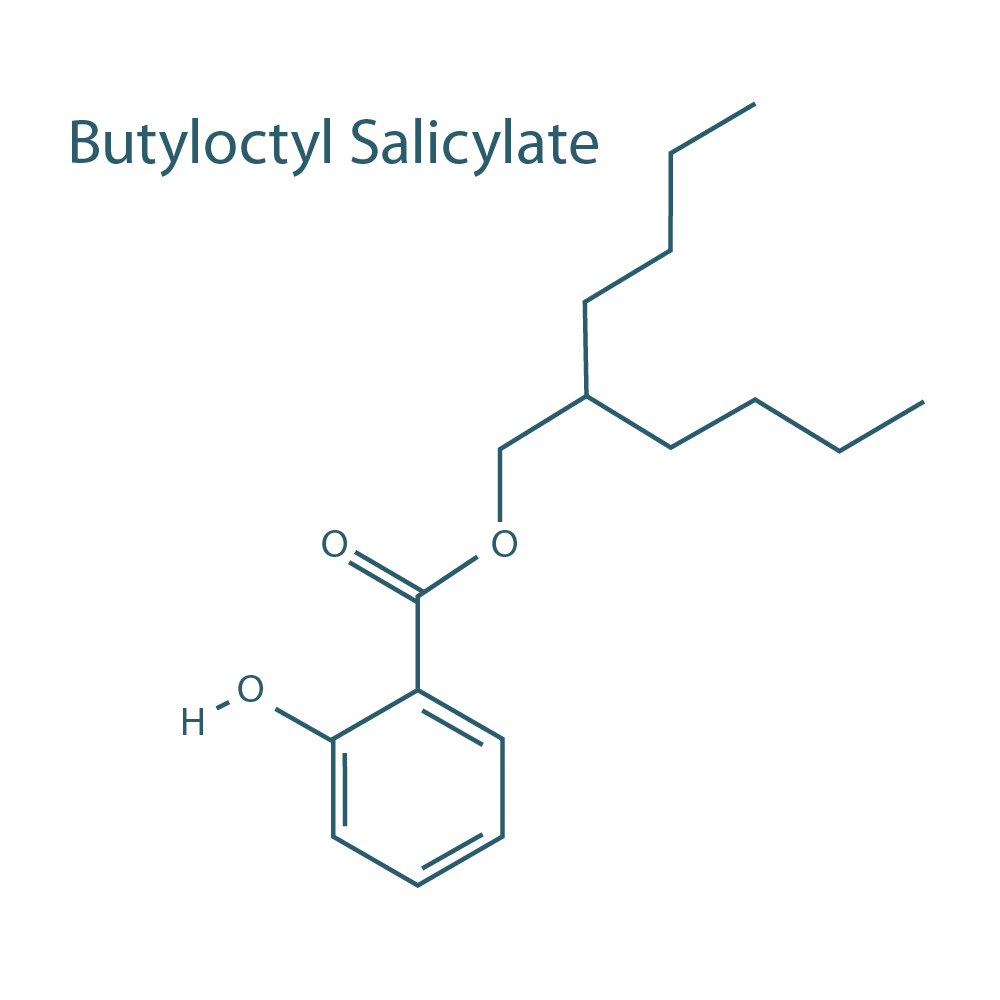
Butyloctyl Salicylate is an ester of salicylic acid and butyloctyl alcohol. It is mostly used in the cosmetic industry. It is a solvent and UV filter. EWG rates butyloctyl salicylate as 1-4 depending on usage, meaning the safety is subject to concentration or use restrictions.
Butyloctyl salicylate has uses beyond sunscreen and may be included in cosmetic products because it helps color pigment particles stay in suspension and spread easily on skin.
The same properties that allow butyloctyl salicylate to spread makeup pigments also help mineral sunscreen pigments spread on skin more easily.
Although Butyloctyl Salicylate has UV filtering properties, it is not on the list of approved UV filters by the FDA and therefore, it is not required to be listed in a sunscreen’s OTC ACTIVE sunscreen ingredient portion of the ingredient list. In the active ingredients, it is required to list the percentage of the FDA approved UV filter contained.
Why is butyloctyl salicylate used in some mineral sunscreens?
Butyloctyl salicylate helps to improves the skin feel of mineral UV filters, and it also provides some UV filtering capabilities of its own.
Using 5% butyloctyl salicylate in a formula will generally offer a boost of 2 units of SPF rating. So if a product would otherwise achieve an SPF of 28 a manufacturer can reach SPF 30 by including butyloctyl salicylate with the same amount of minerals. Consumers generally want to purchase products with higher SPF ratings due to marketing and dermatologist recommendations of specific SPF levels. This means brands will generally work to achieve SPF ratings that will sell the best.
Zinc oxide and titanium dioxide are both excellent, safe UV filters. The downside to mineral sunscreens is that they can make skin look ghostly white, and can have a drying or sticky skin feel or be hard to spread. Due to these undesirable properties manufacturers have looked for ways to make their mineral sunscreen products more pleasant to use.
It can also be challenging to achieve SPF 50 rating with only mineral UV filters. A blend of zinc oxide, titanium dioxide, and some butyloctyl salicylate may be used for SPF 50 products to reduce white cast and achieve the desired, highly marketable SPF 50 rating.
How does butyloctyl salicylate work to boost SPF?
Like other chemical sunscreen UV filters, butyloctyl salicylate provides UV protection by absorbing UV rays and transmitting them as heat into the skin.
A core portion of the molecule is responsible for this UV absorbency behavior. This core part of the molecule happens to be the same structure that exists in FDA approved and regulated UV filters like octisalate, which is also known as ethylhexyl salicylate or octyl salicylate.
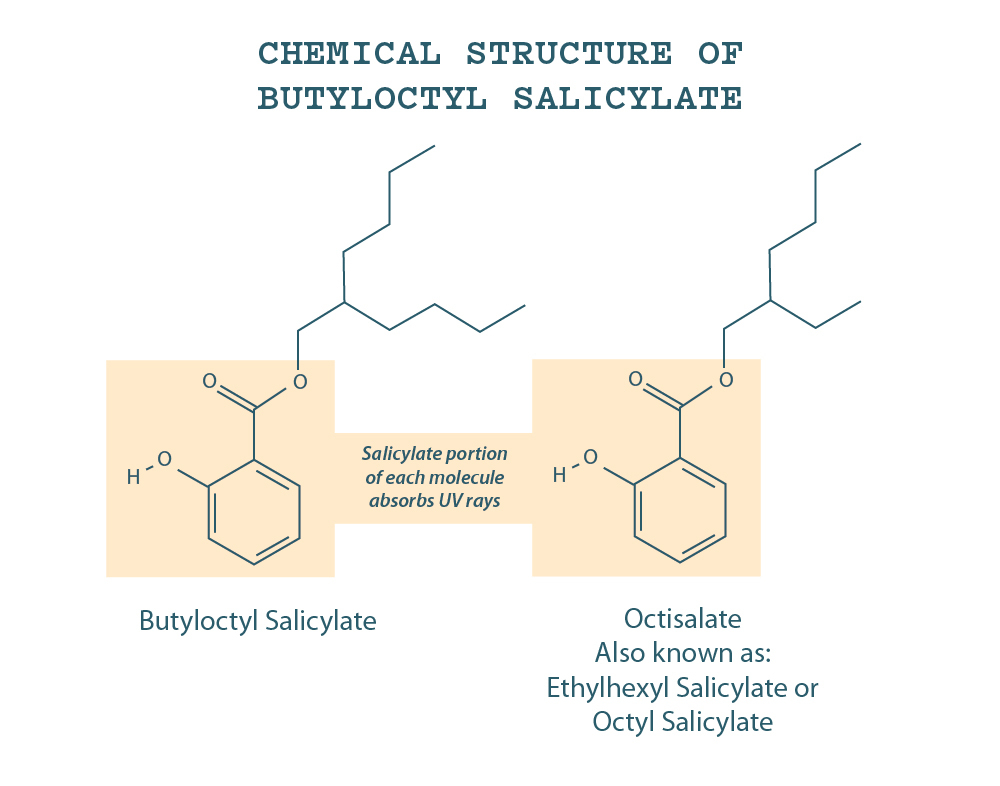
Butyloctyl salicylate is known to absorb UV rays in the 295 - 315 nm range with peak absorbency at 307 - 310 nm. This is firmly in the UVB range.
We can substantiate this further by looking at its close relative, octisalate. Octisalate is primarily protective against UVB rays. It absorbs UV rays with a length of 295-315 nm. It is not a strong UVA protective compound. UVA rays have a length of 315-400 nm.
Butyloctyl salicylate acts similarly to octisalate, and therefore would boost UVB protection but not UVA protection.
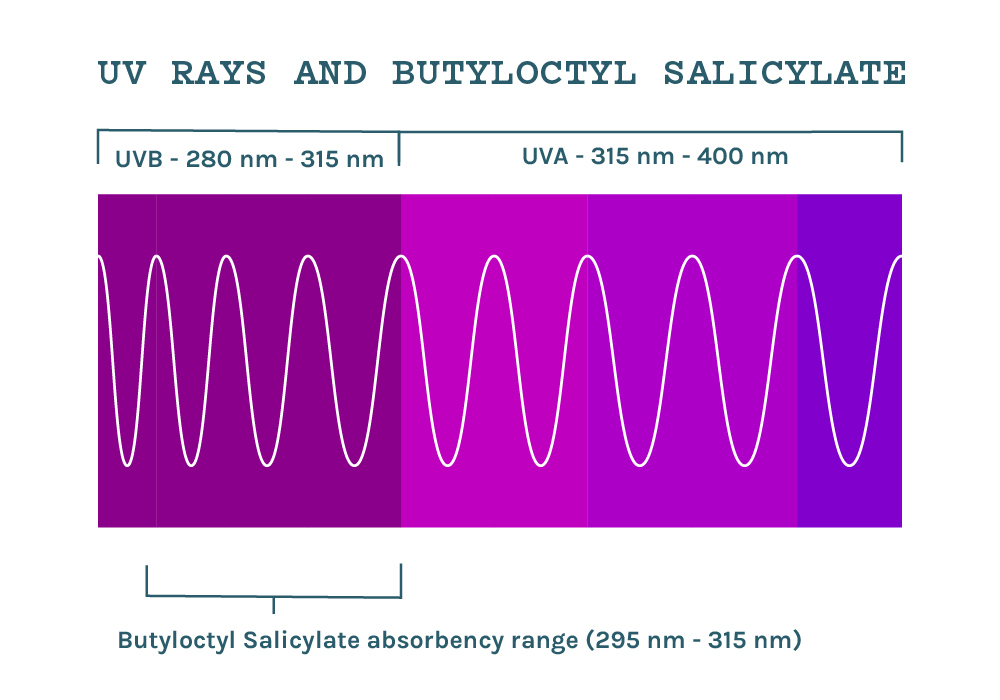
Butyloctyl salicylate’s one-sided UV absorbency should concern anyone that is buying mineral sunscreen for its broad spectrum protective properties. Any portion of zinc oxide that is replaced with butyloctyl salicylate will deceptively increase SPF rating without providing a corresponding UVA protective ability. This means you’re sacrificing protection against UVA rays that penetrate deeply into skin to cause breakdown of skin firmness and trigger potentially cancerous damage.
Zinc oxide is the best broad spectrum UVA + UVB filter. Reducing its concentration in mineral sunscreens will leave you more vulnerable to long term sun damage.
Are other chemicals besides butyloctyl salicylate used for “doping” sunscreens?
Yes, other compounds besides butyloctyl salicylate may be used for “doping” sunscreens in order to use less zinc oxide and titanium dioxide.Other “doping” compounds that may show up in your sunscreens include:
- Tridecyl salicylate
- Capryloyl salicylic acid
- Ethyl ferulate
- Diethylhexyl syringylidenemalonate
What sunscreen brands are “doping” mineral sunscreens with butyloctyl salicylate and similar compounds?
Unfortunately in 2026 the answer is that many “mineral” sunscreen brands are using some butyloctyl salicylate and other “doping” compounds to boost their SPF test results while offering a more pleasant product application.

Popular sunscreen brands that have been using this tactic include select products from Elta MD, La Roche Posay, Supergoop, Alba Botanica, Babo Botanicals, Sun Bum, Neutrogena, Cetaphil, and many others.
Even “natural” and “independent” brands often include butyloctyl salicylate. Small brands may not have an on-staff chemist, and chemists at contract manufacturers push them to include it to make sunscreen formulation easier.
There is no substitute for reading the ingredients label of a sunscreen before purchasing.
How we made a mineral sunscreen without butyloctyl salicylate
During formulation of our Photonic SPF 30 Light Shifting Solution Broad Spectrum Mineral Sunscreen we experienced pressure from a manufacturing provider to include butyloctyl salicylate in our facial sunscreen. We sent them our formula to have them make an initial sample. They sent us back a completely altered recipe with butyloctyl salicylate in it when we had not asked for it.
Their sales rep and lab chemists insisted that we needed the butyloctyl salicylate to ensure an SPF rating of 30. After several more unsatisfactory conversations with that provider we eventually left them to find another provider that would help us implement our formula without butyloctyl salicylate the way we originally intended.
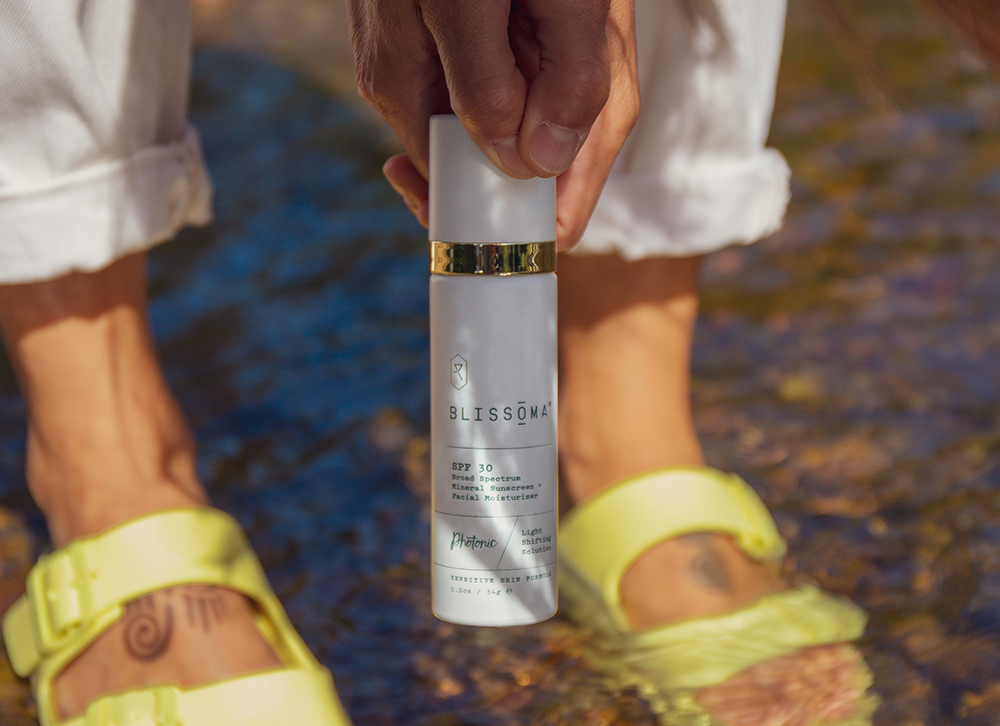
Sadly many small brands may not have the chemistry expertise we do, or ability to produce their own test samples in-house. We had already produced in-house samples that we sent out for early SPF screenings to determine if we were hitting the mark. We knew that our goal was possible and were not swayed by the pressure the manufacturing provider exerted on us.
This highlights the unique quality Blissoma is capable of providing due to our in-house formulation capabilities and stringent dedication to quality and transparency.
What are different countries doing about butyloctyl salicylate?
Sunscreen regulations can vary substantially around the world. Since many USA cosmetics shoppers are turning to internationally made sunscreens to circumvent the limitations of the FDA’s antiquated regulations it’s worth knowing what’s typical for sunscreens coming from other markets.
- Butyloctyl salicylate is not considered an official UV filter in sunscreens from South Korea and exists in a regulatory gray area similar to the United States. It is commonly used in Korean “mineral” sunscreens due to demand for lightweight sunscreens with a pleasant skin feel.
- Canada allows butyloctyl salicylate and also classifies it as an “inactive” ingredient.
- The EU and Australia currently both have regulations to limit use of butyloctyl salicylate to a maximum of 5%, and the EU is continuing to assess its safety profile.
How much Butyloctyl Salicylate is in your sunscreen?
According to a 2018 paper butyloctyl Salicylate is sometimes used in cosmetics at rates of up to 35.9% in leave-on products.
Due to the fact that butyloctyl salicylate appears in the “inactive ingredients” area in sunscreens in the USA consumers will not easily be able to determine the percentage used in their sunscreens. Active UV filter compounds must have their percentages declared by law, but inactive ingredients are listed either in order of concentration, or in alphabetical order.
Typical USA sunscreen labeling has inactive ingredients declared in alphabetical order. In the EU sunscreens are considered a cosmetic product, and follow cosmetic labeling rules that require ingredients to be declared in descending order of concentration.
Given that butyloctyl salicylate starts with b you can expect to see it declared quickly in the inactive ingredients area of sunscreens in the USA.
One chemical manufacturer of butyloctyl salicylate recommends a usage rate of 2-10%. The EU and Australia both place a limit of 5% concentration for the use of butyloctyl salicylate in sunscreens.
How Safe Is Butyloctyl Salicylate?
There are not a lot of easy to find clinical studies on butyloctyl salicylate specifically because it is not a FDA-approved UV filter. Most of the information on this ingredient deems it safe in a specific concentration, although companies in the US are allowed to use it at much higher concentrations.
So here’s the kicker… butyloctyl salicylate is a very close relative to FDA-approved chemical UV filters homosalate and octisalate. A little too close for comfort... In fact the structures of butyloctyl salicylate and octisalate are nearly identical, making butyloctyl salicylate functionally a sneaky substitute for octisalate in sunscreens.
The concern is centered at the fact that these chemicals, as well as butyloctyl salicylate, penetrate and absorb deep into the skin, stay in your skin far after use and can also be found in the bloodstream. One study showed that both homosalate and octisalate were found in the blood and skin of test participants 21 days after the initial application.
A 2025 safety assessment on a range of salicylate cosmetic chemicals included a discussion of a study where application of octisalate over 48 hours resulted in excretion of 1-2% of the applied chemical in the urine of study volunteers. Given that this was a short term study no long term systemic health or safety effects were determined.
Octisalate is such an effective skin penetration enhancer that it has been used to enhance skin penetration of drug compounds like testosterone and fentanyl.
That same paper also concluded that while octisalate did not tend to bind to estrogen receptors butyloctyl salicylate did have an ability to bind to estrogen receptors.
Until more studies are conducted cautious shoppers may wish to avoid butyloctyl salicylate due to its potential hormone disrupting effects.
And, don’t forget, butyloctyl salicylate reduces your level of UVA protection, making you less safe from the sun versus sticking to all zinc oxide!
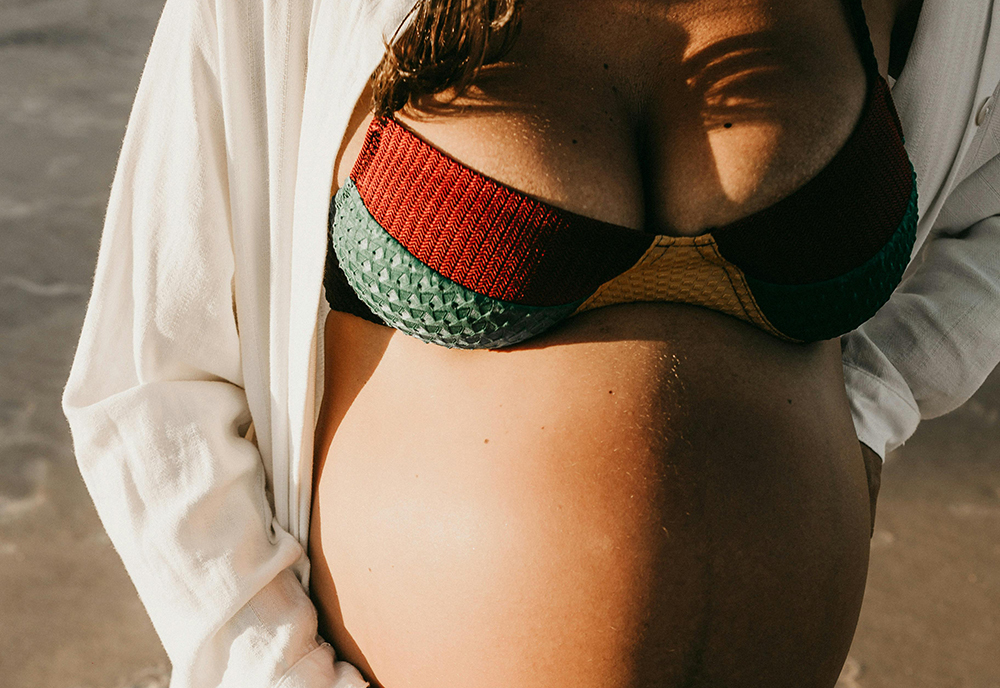
Is Butyloctyl Salicylate Pregnancy Safe?
Salicylates have often come into question for their safety for use during pregnancy. This is in large part due to the capability of salicylic acid to cross the placenta and impact fetal health. Not all salicylates are transformed into salicylic acid when topically applied.
The Campaign for Safe Cosmetics calls out homosalate as a concern specifically for babies, children and pregnant women because of its endocrine disruptive capabilities and that the use of these ingredients in sunscreen during pregnancy correlates with its discovery in breast milk.
Also mentioned is its skin absorption ability and that it can bring other chemicals deep into the body and bloodstream, including pesticides from bug repellent when used in tandem with UV filtering products. No, thank you!
In addition, A study emerged due to the connection between the rise in the usage of sunscreen with UV filters paralleled with the rise in malignant melanoma and matched with experimental studies signaling many chemical UV filters might be endocrine disruptors. Homosalate was included in this study and was shown to block the activity of the progesterone receptor, which is a key hormone for pregnancy and reproduction. In addition, HMS was shown to interfere with male hormones. This study also references an observational study where homosalate, along with other popular chemical UV filters, were found in breastmilk.
Finding A Mineral Sunscreen Free of Butyloctyl Salicylate
When you know, you know. And now that you know why butyloctyl salicylate is used in mineral sunscreen and why you might not want it on your skin and body, there are transparent, high performance mineral sunscreen alternatives that are butyloctyl salicylate-free. Sunscreen should not only protect your skin from sunburn and the long-term damage from oxidative stress from excessive UVA and UVB exposure, it should also nurture your skin with ingredients that improve your skin's appearance, support its health and be free of common allergens and irritants making it safe for sensitive skin. There is a better way.
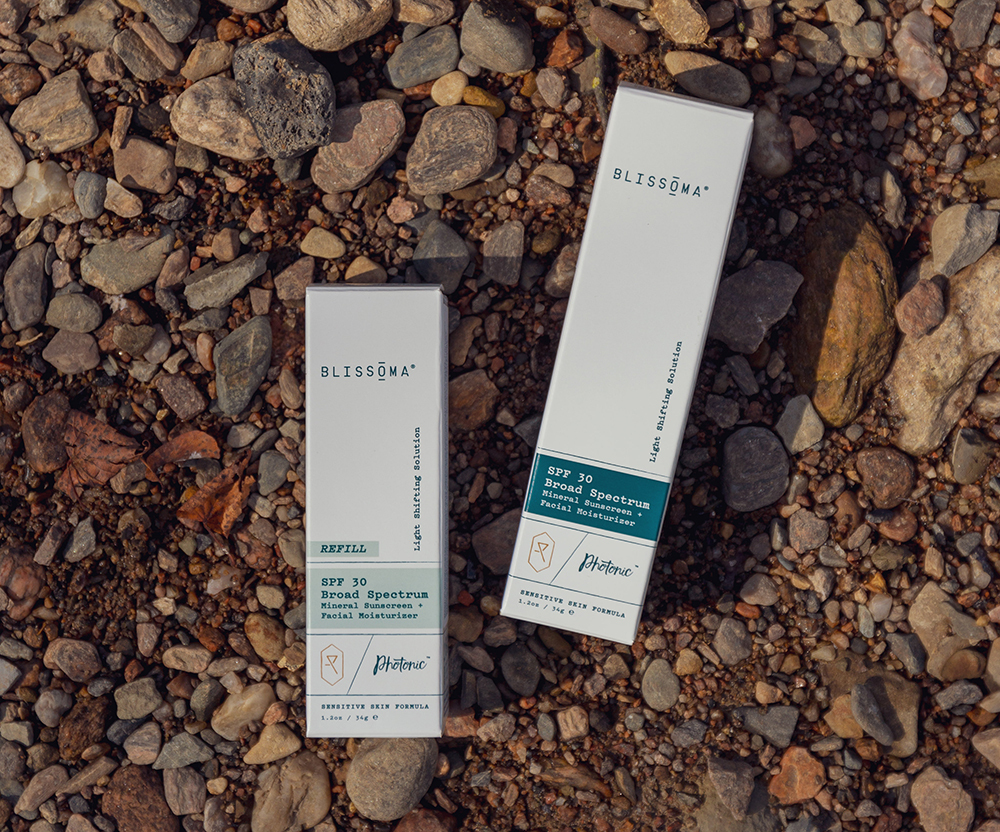
Being informed empowers us to make better choices and advocate for our own well-being. By asking questions, reading labels, and seeking out trusted sources, we ensure that we’re not just relying on manufacturers’ claims, but are actively taking charge of our health and supporting companies that support us.
Disclaimer: The information contained on this site is general in nature and for informational purposes. It is not meant to substitute for the advice provided by your own physician or other medical professional. None of the statements on this site are a recommendation as to how to treat any particular disease or health-related condition. If you suspect you have a disease or health-related condition of any kind, you should contact your health care professional immediately. Please read all product packaging carefully and consult with a healthcare professional before starting any diet, exercise, supplementation or medication program. Cosmetic products have not been evaluated by the Food and Drug Administration and are not intended to diagnose, treat, cure, or prevent disease.